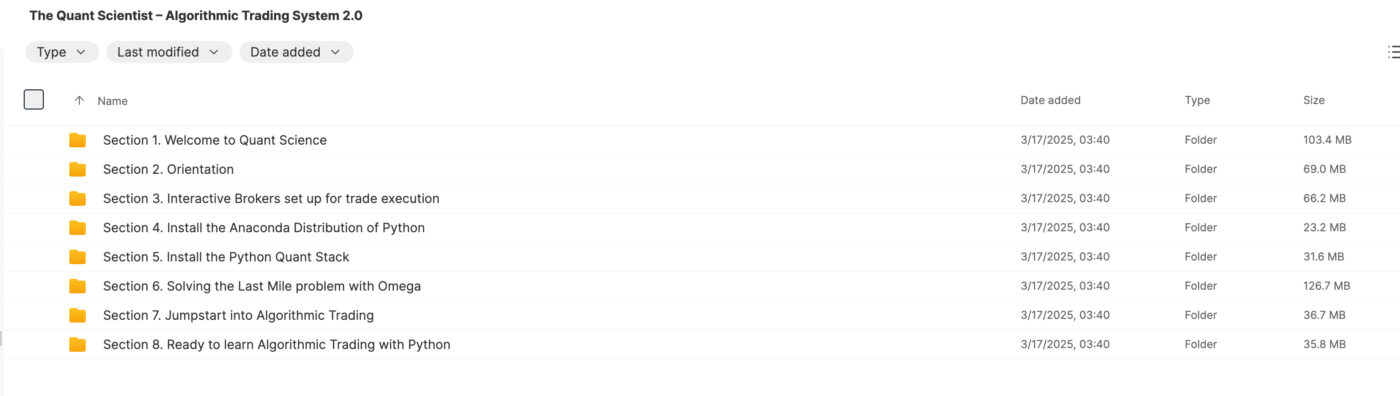
What is it? The Algorithmic Trading System 2.0 is a comprehensive course teaching how to build, test, and deploy automated trading strategies using Python and quantitative methods. The Algorithmic Trading System 2.0 System 2.0 covers strategy development, backtesting, risk management, and live implementation—designed for traders who want to move from discretionary trading to systematic, rule-based approaches that can run without constant manual intervention.
Verified Deliverables:
- Complete Algorithmic Trading System 2.0 curriculum
- Video training with code walkthroughs
- Python code templates and frameworks
- Backtesting examples and datasets
- Delivery: Mega & Google Drive
- Access: PC, Tablet, Mobile
- Lifetime access included
Why Algorithmic Trading in 2025
Manual trading requires being at the screen to execute. You miss opportunities while sleeping or working. Emotions cause you to deviate from your plan at the worst moments. Algorithmic trading solves these problems by codifying rules and letting computers execute without hesitation. Markets have become faster and more competitive—traders who automate their edge can scale it while those clicking manually hit natural limits. The barrier to entry has dropped dramatically with Python libraries handling the complex parts, and for complementary training in quantitative analysis, the Complete Trading Bundle provides related quantitative techniques.
Technical Setup and Platform Configuration
Before writing a single line of strategy code, proper setup determines success. The course walks through configuring your development environment with Python 3.8+, Jupyter notebooks for interactive development, and essential libraries including pandas for data manipulation, numpy for numerical operations, and matplotlib for visualization. Trading platform connectivity requires setting up API credentials with brokers like Interactive Brokers (TWS API), Alpaca, or TD Ameritrade. Backtrader or Zipline serve as backtesting engines, while data feeds from Yahoo Finance, Alpha Vantage, or premium sources provide historical price information. The curriculum covers installing these components correctly and troubleshooting common setup issues that trip up beginners.
What Algorithmic Trading System 2.0 Teaches
Algorithmic Trading System 2.0 starts with Python fundamentals specifically for trading applications. You don’t need to become a software engineer—just enough coding to implement strategies. Strategy development modules teach turning trading ideas into testable code. Backtesting sections show how to properly evaluate strategies without overfitting to historical data, a mistake that destroys most algo traders. Risk management coding implements position sizing and drawdown controls programmatically. Live deployment training covers connecting to brokers and monitoring running systems. Traders who want to combine algorithmic execution with discretionary analysis will find QuantProgram Prometheus provides the analytical foundation that complements automated execution.
Rule-Based Entry Logic Checklist
Every algorithmic strategy requires explicit, testable rules. Algorithmic Trading System 2.0 teaches a systematic entry framework:
- Signal Generation: Define exact conditions (e.g., 20-period SMA crosses above 50-period SMA with RSI > 50)
- Filter Conditions: Apply regime filters (only trade when ADX > 25 indicating trend strength)
- Time Filters: Restrict trading to specific sessions (9:30 AM – 4:00 PM EST for US equities)
- Position Sizing: Calculate shares based on ATR-based stop distance and 1% account risk
- Entry Execution: Use limit orders at signal price or market orders for momentum strategies
- Confirmation Logic: Wait for bar close before triggering to avoid intrabar whipsaws
- Order Validation: Check sufficient capital, position limits, and no conflicting open orders
Backtesting Done Right
Most algo traders fail because they backtest wrong. They optimize until historical results look amazing, then watch the strategy fail live. Algorithmic Trading System 2.0 teaches proper backtesting methodology: out-of-sample testing, walk-forward analysis, and realistic assumptions about slippage and commissions. Understanding why backtests lie matters most before trusting one. The curriculum covers common pitfalls like survivorship bias, look-ahead bias, and curve fitting that inflate backtested results beyond what’s achievable in live trading.
Discretionary vs Algorithmic Trading
| Aspect | Discretionary | Algorithmic |
|---|---|---|
| Execution | Manual clicks | Automated |
| Emotions | Affect decisions | Eliminated |
| Scalability | Limited by attention | Multiple strategies |
| Time required | Constant monitoring | Periodic review |
Note: These parameters are optimized for traders transitioning from discretionary to systematic trading. Your results will vary based on strategy complexity and market conditions.
Algorithmic Trading System 2.0 Strategy Process
Good algorithmic trading starts with a trading idea based on market inefficiency. Algorithmic Trading System 2.0 teaches a systematic process: idea generation, hypothesis formation, coding, testing, and refinement. Most ideas don’t work—and that’s expected. Having a process to quickly test and discard bad ideas while improving promising ones is the skill that matters. The curriculum shows how to generate strategy ideas from market observation and academic research, then translate them into testable code. The AAA Quants Trading Bundle provides systematic discretionary methods that can complement your algorithmic approach.
Live Deployment Considerations
A working backtest is just the start. Deploying live introduces challenges: broker connectivity, order management, error handling, and monitoring. The course covers practical deployment issues that tutorials skip. Learning to handle disconnections, partial fills, and unexpected market conditions prevents costly live trading errors. Position sizing rules ensure single strategy failures don’t damage the overall account.
About Algorithmic Trading System 2.0 Creator
The Quant Scientist specializes in algorithmic trading education using Python and quantitative methods.
The Quant Scientist provides algorithmic trading education focused on practical implementation rather than academic theory. The 2.0 version updates the curriculum for current Python libraries and market conditions.
Risk Management in Automated Systems
Algorithms can lose money faster than humans can click. Without proper risk controls, a bug or market anomaly can drain accounts in minutes. The course covers implementing automatic stop-losses, position limits, and drawdown breakers that halt trading when something goes wrong. These safeguards are non-negotiable for live algorithmic trading. Traders interested in complementary automation approaches may find NinjaTrader 8 Algo Bot Trading123 provides additional platform-specific techniques.
Who This Course Is For
- Traders with profitable manual strategies who want to automate
- Programmers interested in applying skills to trading
- Traders tired of emotional execution mistakes
- Anyone wanting to trade multiple markets simultaneously
- Those seeking passive income from trading systems
For more systematic trading education, explore Algorithmic Trading courses on GeniTrader, and students interested in expanding their quantitative skills may also benefit from the Alpha Quant Program for advanced quantitative analysis techniques.
Why get it here: Original price $2,499 — instant download at a fraction of the cost. If the link breaks, we replace it within 24 hours. 30-day money-back guarantee if files are corrupt.
Algorithmic Trading System FAQ
What is the Algorithmic Trading System 2.0?
Complete course teaching how to build, backtest, and deploy automated trading strategies using Python.
Do I need programming experience?
Basic familiarity helps but isn’t required. Algorithmic Trading System 2.0 teaches Python fundamentals for trading.
Is this the complete course?
Yes. Full 2.0 curriculum with all modules, code, and materials.
What Python libraries does the course use?
The curriculum covers pandas for data manipulation, numpy for numerical operations, Backtrader/Zipline for backtesting, and broker APIs (Interactive Brokers, Alpaca) for live execution.
How long does it take to build a profitable algorithm?
Expect 3-6 months of development and testing before live deployment. Most initial strategies fail—the course teaches iteration and improvement rather than quick wins.
How do I access it after purchase?
Instant download link provided immediately after payment.
What if the download link doesn’t work?
Contact us and we’ll replace it within 24 hours.
Is there a refund policy?
Yes. 30-day money-back guarantee if files are corrupt or incomplete.