
TL;DR: Why do so many traders sell the exact bottom? Because falling markets manufacture false breakdowns, and the Bear Trap Indicator course by Markay Latimer exists to catch them. Built around the 4-hour chart, it teaches how bear markets behave, how to recognize a trap before it springs, and how to trade the reversal with defined risk, backed by case studies from real markets.
The Idea Behind the Bear Trap
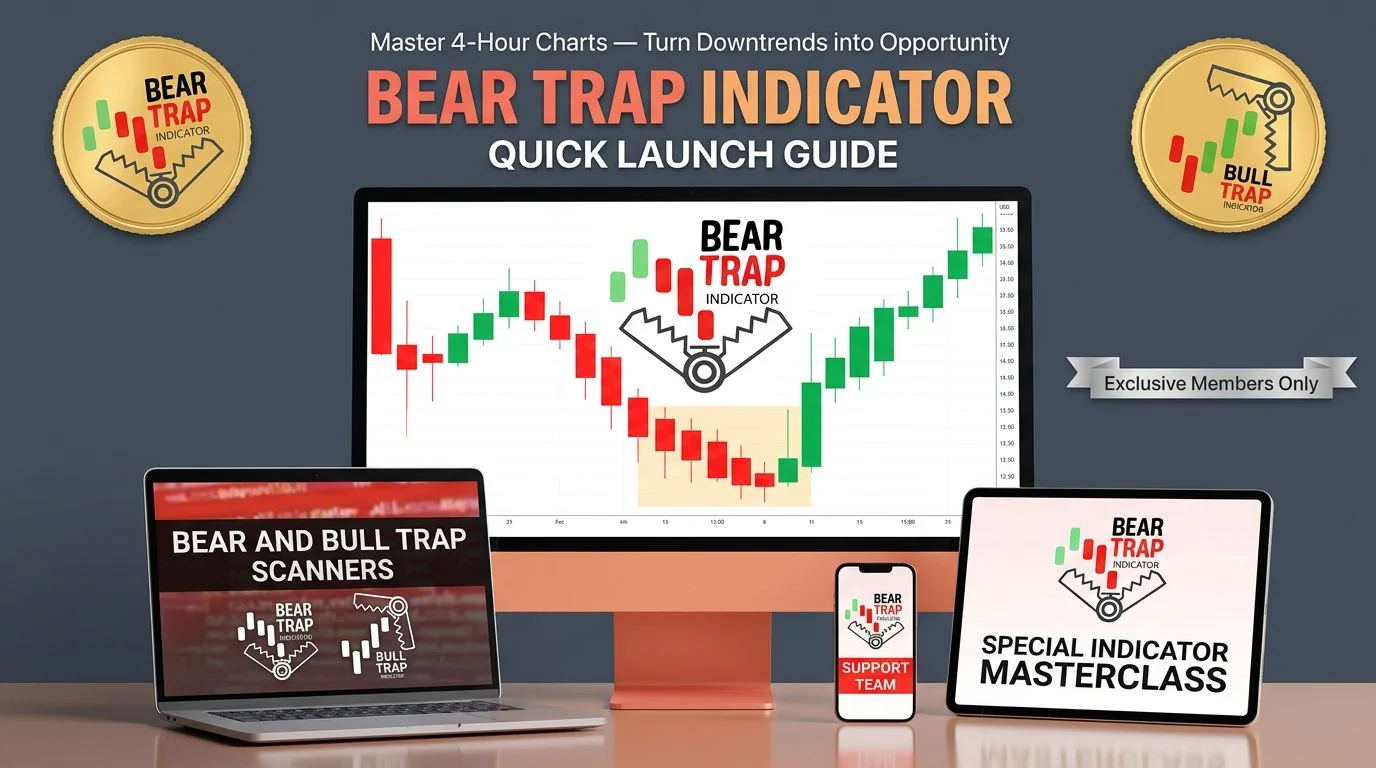
The Bear Trap Indicator course is a stock-trading program by Markay Latimer that teaches traders to identify false breakdowns, moments where price breaks support, triggers the sellers, then reverses hard against them; Investopedia’s definition of a bear trap describes the same mechanic in neutral terms. Latimer’s material covers the fundamentals of bear markets first, because traps are a bear-market specialty: fear is highest exactly where the reversals are born.
Why the 4-Hour Chart
Everything in the method is optimized for the 4-hour timeframe, deliberately. Four-hour candles filter the intraday noise that makes trap-spotting nearly impossible on 5-minute charts, while still giving several decision points per week. That choice cuts both ways: if your style is scalping or multi-month investing, this timeframe will feel foreign. The honest read is that this course serves swing traders holding positions for days, not minutes and not quarters.
From Theory to Live Application
The course moves from interpreting 4-hour structure to applying the bear trap indicator in real time, then anchors it with case studies that walk through actual trapped breakdowns. Risk control gets its own treatment, sensibly, since a genuine breakdown looks identical to a trap until it does not, and the difference is managed with stops, not certainty. The package also includes Latimer’s promotional webinar, which is more pitch than lesson; the value lives in the core modules.
Match It to Your Trading Style
- Swing traders working daily and 4-hour charts on stocks
- Dip buyers who keep getting stopped at the lows and want a structure for it
- Traders who learn from annotated case studies over abstract theory
- People building counter-trend skill on top of supply and demand zone trading
Look elsewhere if you scalp low timeframes, hold for years, or want a mechanical alert that removes judgment; reading a trap still takes reps.
About Markay Latimer
Markay Latimer is a veteran stock trader and educator known for turning a small account into a substantial one through technical swing trading, and she has taught chart-reading for two decades. Where Elliott Wave forecasting for forex projects the next move from wave structure, Latimer’s edge is narrower and more situational: catching the failed move everyone else fell for. The two approaches complement rather than compete.
Bear Trap Indicator: Common Questions Answered
What is the Bear Trap Indicator course?
It is Markay Latimer’s program teaching traders to spot and trade false breakdowns, bear traps, on 4-hour charts, covering bear-market behavior, real-time application of her indicator, case studies, and risk rules.
Who is it for?
Stock swing traders working the daily and 4-hour timeframes and want a repeatable way to read failed breakdowns instead of guessing at bottoms.
Is the Bear Trap Indicator worth it?
For swing traders who repeatedly get shaken out at lows, yes; the trap-recognition framework targets that exact leak. Scalpers and long-term investors will find the 4-hour focus mismatched.
Is it legit?
Latimer has taught chart-reading publicly for two decades, so the pedigree is verifiable with a long public track record, and the course content matches what her brand has taught for years.
Do I need experience?
Basic chart literacy helps, support, resistance, and candlesticks, since the course builds the trap concept on top of standard technical reading.
Final Word on the Trap-Trading Method
Most losing trades in down markets come from believing a breakdown that was bait. Latimer’s course gives that moment a name, a chart pattern, and a playbook, and pairs it with sober risk management and the patience that good price-level reading demands. It teaches a skill. It does not tell you what to buy or sell.


